
Milan Ćurković
Faculty of Electrical Engineering, Mechanical Engineering and Naval Architecture (FESB), University of Split
From light patterns to answers: structured-light 3D scanning, parametric spline models of measured surfaces, and machine learning that links changes in shape to the state of what was measured.
- Email milan.curkovic@fesb.hr
- Projected fringes
- Spline model
- Control points
Research
Shape carries information about the state of the system behind it.
The shape of an object, and the way that shape changes over time, says something about its condition, whether the object is a machine part or a human face. The research builds the chain of methods that turns raw optical measurements into that information.
-
Structured-light 3D scanning
Phase shifting, Gray coding, camera–projector calibration and robust correspondence extraction on reflective or poorly lit surfaces.
-
Spline surface modelling
Fitting smooth surfaces to measured point clouds with hierarchical splines, with optimised parameterisation and automatic adaptive refinement.
-
Shape optimisation and reverse engineering
Geometry parameterisation for shape optimisation, and reconstruction of CAD models from measured data.
-
Image processing and learning
Interpretable models that combine splines with learning, such as document binarisation driven by a learned spline decision surface.
Method
From a scan to the state of a system, in five steps.
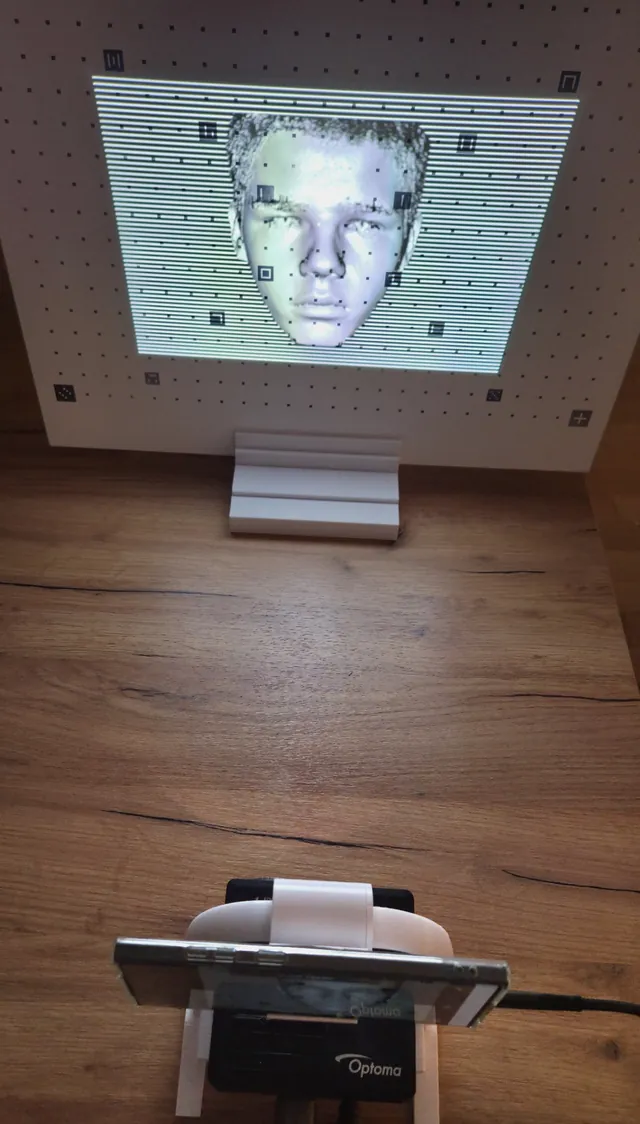
Acquisition
A portable scanner with a camera and a projector, calibrated on a reference target, captures shape and colour repeatably.
Phase and correspondence
Phase images from the projected patterns give camera–projector correspondences, even on shiny or dim surfaces.
Parametric model
A smooth spline surface gives every scan the same parameterisation; the measured detail is stored as fields over it, and gaps in the scan are bridged by the surface.
Registration
Scans are aligned to a reference model to produce displacement maps in millimetres, colour changes and regional features.
Linking to measurements
Geometric change is related to independent measurements of the system's state with statistics and machine learning.
- Medicine
- Contactless estimation of physiological state; currently diabetes.
- Industry
- 3D measurement, deviation analysis, quality control and CAD reconstruction.
Selected results
Current projects, with the method applied to real measurements.
Publications
Selected journal and conference papers. Filter by topic.
Teaching
Course materials are on Merlin.
Professional projects
Applied work with industry and other institutions.
Contact
For collaboration on 3D measurement, geometric modelling or quality control, or for questions about courses, write to milan.curkovic@fesb.hr.